top of page


Airbus X Delta Airlines
Closed-Loop Catering Data Platform
SPONSORED PROJECT
PRODUCT DESIGN
SYSTEM DESIGN


January 2025 - May 2025. I Atlanta, Georgia
PROJECT OVERVIEW
Worked with the Delta Sustainability team as part of the Airbus-led SESAME (Sustainable, Efficient, Safe Air Travel by Management and Engineering) initiative.
Using journey mapping, service blueprinting, and DMAIC-informed process improvement, we examined the end-to-end catering ecosystem across passengers, cabin operations, catering teams, vendors, and sustainability stakeholders to identify operational gaps, handoffs, waste drivers, and opportunities for improvement.
PROJECT GOAL
The overarching goal was to support Delta Air Lines in advancing its commitment to achieve net-zero carbon emissions across operations by 2050.
Designed a centralized catering intelligence platform that connects passenger preferences, in-flight consumption, food waste, and operational data to help Delta identify patterns, improve provisioning decisions, and reduce food waste.
PROJECT CLIENT
Delta Airlines Sustainability Team + Airbus
PROJECT ROLE
Irene Jacob ( Product Designer & Researcher, Project Manager, Berkeley Chandler (Researcher) and Qun Liu( Product designer)
International Recognition: Crystal Cabin Award Finalist


This project was selected as a finalist for the Crystal Cabin Award, and we presented our work in Germany in Spring 2026.


THE PROBLEM THAT SHAPED THE ENTIRE PROJECT - DELTA'S INTERNATIONAL ECONOMY FLIGHTS

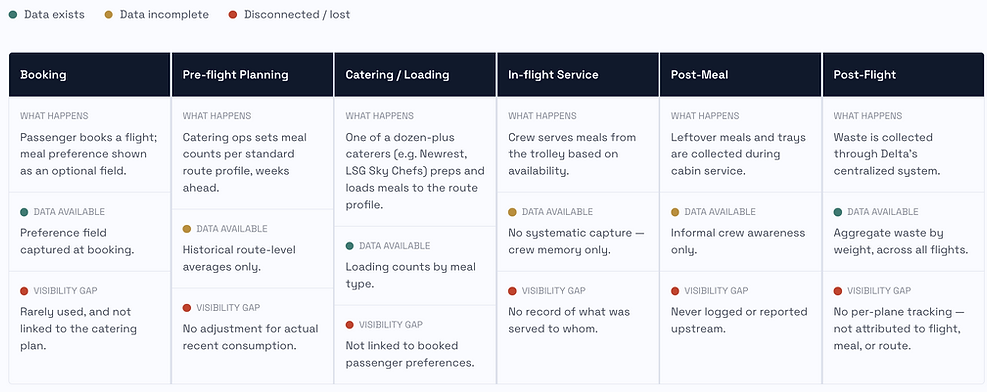
Passenger personalization (e.g., dietary needs) isn’t fully integrated into inflight provisioning, despite existing data collection opportunities.
Real-time feedback loops on consumption are weak, current systems don’t track what’s left uneaten or wasted post-flight.
There is no system that links onboard waste back to specific flights, passengers, or meal types, collected waste is aggregated into one system.
Delta operates a centralized food waste collection system that aggregates waste from all flights, without tracking data on a per-plane basis.
Fragmented data across Delta’s catering ecosystem limits personalization and waste reduction, presenting an opportunity for a unified, closed-loop data system.
DESIGN CHALLENGE


FINAL OUTCOME
From fragmented catering data to actionable insights.
Rethinking DELTA’S Airline Catering
The Closed-Loop Catering Intelligence Platform connects passenger preferences, flight-level meal activity, consumption, waste, vendors, and provisioning into one operational system.
It gives catering teams visibility into what is planned, loaded, served, consumed, and wasted, then feeds those insights back into future planning.
CLOSED LOOP DATA FLOW
ENTERPRISE SaaS

THE CLOSED LOOP SYSTEM - SYSTEM REDESIGN
Redesigning Delta’s international economy catering journey as a connected data system - Future state
We started the project that looked beyond a single digital product.
We redesigned how passenger preferences, catering operations, meal service, feedback, consumption, and waste data could connect across the flight journey, creating a closed loop that learns from one flight and informs the next.

THE DIGITAL INTELLIGENCE LAYER
Designed as a catering-specific extension of Delta’s existing operational platform, SkyPulse
The redesigned service creates new signals across passenger, service, and operational touchpoints.
The Catering Intelligence Platform brings those signals together, so catering teams can make better forecasting, provisioning, menu, and allocation decisions.


While the redesign spans the full catering journey, this case study focuses on the platform that brings that data together.
PLATFORM EXPERIENCE - FINAL DESIGNS
Turning the closed loop into 5 connected operational experiences.
01.
MONITOR THE CATERING NETWORK
Overview / Dashboard
A real-time starting point for catering operations, showing active flights, meals served, consumption signals, and food-waste rate alongside the live network map and priority issues that need attention.
NETWORK HEALTH MONITORING
LIVE CATERING PERFORMANCE
FOOD + WASTE DATA
02.
TRACE CATERING ACTIVITY ACROSS A FLIGHT'S LIFECYCLE
Flight Intelligence
Search and compare upcoming, in-flight, and completed flights, then drill into a specific flight to see passenger choices, seat/tray data, consumption, waste, and vendor context.
Every flight connects the chain from planned → loaded → served → consumed → wasted.
ROUTE & AIRPORT FILTERING
PASSENGER CHOICE DATA
FLIGHT CATERING LIFECYCLE VIEW
03.
TURN DEMAND SIGNALS INTO BETTER CATERING PLANS
Meals & Provisioning
The planning workspace for forecasting, menus, vendors, and inventory: demand forecasting → menu configuration → supply & vendors → inventory & offerings → flight allocation.
Inventory is split into Flight Meals, Pantry & Beverages, and Partner Offerings, each tracked as perishable or non-perishable.
PERISHABLE / NON-PERISHABLE TRACKING
VENDOR CATERING PERFORMANCE
ROUTE & HUB DEMAND FORECASTING
04.
TRACE WHERE FOOD IS CONSUMED AND WHERE WASTE OCCURS
Consumption & Waste
Moves from network-level waste patterns down to route → flight → cabin/section → meal → seat & tray, distinguishing perishable from non-perishable waste and sealed, unopened returns.
Vendor context adds traceability without implying vendor responsibility for the waste.
PER FLIGHT - PER PASSENGER WASTE DATA
CONSUMPTION PATTERN TRACKING
MEAL-LEVEL WASTE INSIGHTS
05.
TURN INSIGHTS INTO COLLABORATIVE FOLLOW-UP
Review Center
A centralized workspace for alerts, pinned insights, and follow-ups. Teams review supporting evidence, add notes, share findings, assign stakeholders, and resolve items — source → evidence → insight → review → follow-up — without treating the system as an autonomous decision-maker.
DATA- DRIVEN ANALYSIS
EVIDENCE-BASED FOLLOW-UP
SUSTAINABILITY REPORTS
RESEARCH SUMMARY
Understanding the current state before designing the future state
We combined human-centered research with a DMAIC-informed process improvement approach to understand the catering ecosystem, establish the current state, identify operational breakdowns, and define opportunities for a more efficient closed-loop service

FORMATIVE RESEARCH
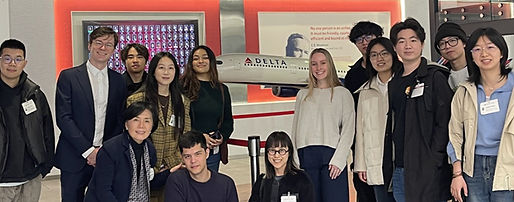
Went into the environment & learned directly from the people running it.


PRIMARY RESEARCH
Stakeholder interview - Delta + Airline Caterers
Three operational perspectives exposed the same information gap across catering planning, provisioning, and waste visibilit

SECONDARY RESEARCH
What broader research added
We complemented stakeholder conversations with literature review, circular design research, and a technology + prior art scan to understand the broader forces shaping catering operations, waste, and personalization

Together, secondary research showed that the core issue was not only food waste itself, but the lack of connected data across passenger preference, service, consumption, and post-flight waste.
RESEARCH ANALYSIS

A connected ecosystem, but fragmented information.
Airline catering involves a complex network of people, services, and systems. Food moves through the journey, but information about what happens to that food is often disconnected across stakeholders.
RESEARCH ANALYSIS - DATA MAPPING
Where does catering data currently exist, and where does visibility break down?
KEY FINDINGS
Four things stood between Delta & a usable catering feedback loop.

RESEARCH ANALYSIS
Design opportunities

Data emerged as the missing link between passenger behavior and catering decisions.
TURNING THE CLOSED LOOP INTO A SERVICE MODEL
How the redesigned service creates a continuous data loop.
We mapped how passenger interactions, crew workflows, backstage catering operations, and supporting systems could work together , tracing a single thread of data from booking through post-flight learning.

The full service design model extends beyond what is shown here;
this case study focuses on the platform as the core digital layer of the solution.
IDEATION
System & data architecture
Before any screen was drawn, I mapped how catering's core entities actually relate to one another, so the platform's structure would follow real data relationships, not mirror the isolated systems the data happened to come from.


IDEATION
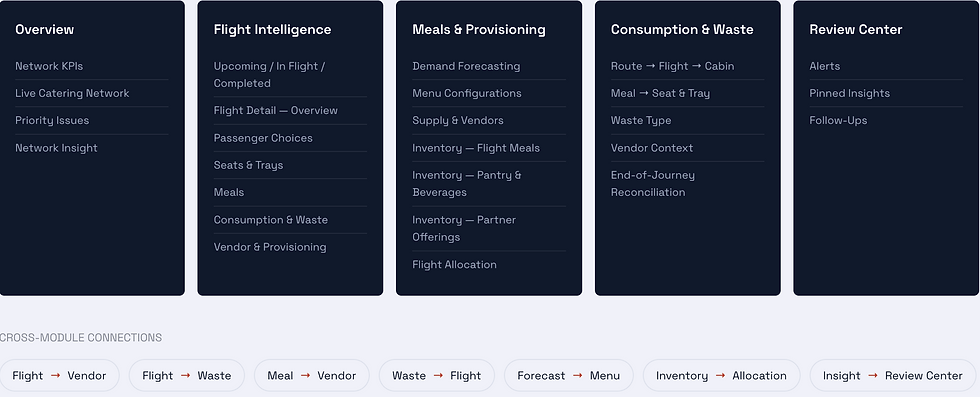
Information architecture
Instead of mirroring the systems where data originated, the architecture follows the questions catering teams need to answer, from what's happening across the network, to why waste occurred on a specific flight, to what should be reviewed next.
IDEATION
Wireframes & Prototypes


SteadyPath : Connected Fall-Prevention Platform
HEALTHCARE DESIGN
ACCESSIBILITY
PRODUCT DESIGN
Designed an accessibility-focused healthcare platform that helps older adults & individuals with cognitive impairments set personalized fall-prevention goals, track daily activities, & stay connected with clinicians through integrated mobile & desktop experiences.
bottom of page